
With the world's worst outbreak of COVID pandemic stalling a nascent economic recovery, the government has begun assessing the impact of the second wave of infections on different sectors and may look at providing support at an appropriate time to segments requiring fiscal help. Some of the economic indicators, including the Goods and Services Tax (GST) collections, still provide confidence and incoming data will throw some more light on the state of the economy, sources said. Services sectors like hospitality, tourism and aviation which had just started recovering were hit hard by the second wave of COVID, the sources said, adding these segments might need some support on an urgent basis from the government.

India may see a structural shift in supplies of crude oil with Russia emerging as a key source of fuels, a development that reduces New Delhi's dependence on West Asian oil, gives Indian refiners better bargaining power with price-setter Saudi Arabia, and improves overall energy security. The unexpected surge in supplies of Russian crude in the last few months, unthinkable until the war in Ukraine, may also deliver other unforeseen gains such as boosting exports of refined fuels to Europe, which historically has counted on Russian shipments. India has jumped on to the bandwagon of opportunistic buying of Russian crude but if calibrated carefully, Urals crude can be a long-term asset for India refiners.

Foreign investors, according to them, will now wait-and-watch how the economy takes shape in the backdrop of doubts over monsoon, interest rate trajectory and other global events such as the US - China trade war.

The Indian economy remains on track to regain its position as the world's fastest-growing major economy after official estimates on Friday put the expansion at a tempered 9.2 per cent this fiscal amid concerns over the impact of a resurgent virus on the fragile recovery. The growth in the gross domestic product (GDP) of 9.2 per cent in April 2021 to March 2022 fiscal (FY 2021-22) given by the National Statistical Office (NSO) in its first advance estimate compares with 9.5 per cent expansion forecast by the Reserve Bank of India (RBI) last month. The economy had contracted by 7.3 per cent in the previous financial year.

Investors with high risk appetite must stay invested while risk-averse investors can consider profit booking.

The global ratings agency keeps India's sovereign rating unchanged at 'BBB-' with stable outlook

Stating that COVID-19 has not yet been contained in India, the rating agency in a statement said the government stimulus package is low relative to countries with similar economic impacts from the pandemic. "The COVID-19 outbreak in India and two months of lockdown -- longer in some areas -- have led to a sudden stop in the economy. That means growth will contract sharply this fiscal year (April 2020 to March 2021)," it said. "Economic activity will face ongoing disruption over the next year as the country transitions to a post-COVID-19 world."

Bank of America (BofA) Securities expects India to be the third-largest economy in the world by 2031. The economic rise could become a reality by 2028, but the Covid pandemic delayed the pace, BofA Securities economists Indranil Sen Gupta and Aastha Gudwani wrote in a report.

Maya Dominic lists her favourite Rihanna numbers.

Stating that an economic recession gripped global economy following the lockdowns due to COVID-19 pandemic, Fitch Ratings on Friday said the initial disruptions to regional manufacturing supply chains in China have now broadened to include local discretionary spending and exports.

Seven years after it announced Nexa, there's no mistaking the seriousness with which Maruti wants the segment to grow, says Pavan Lall.

Despite a massive underperformance at the bourses since the last six months, analysts are turning optimistic on Reliance Industries (RIL). Those at Jefferies, for instance, say that the company is a proxy play for India's consumption growth story. The key catalysts for the stock, according to a Jeffries note, include faster-than-expected market share gain in retail, oil-to-chemicals (O2C) stake sale, recovery in gross refining margins (GRM), potential public listing of Jio and even a possible banking licence going ahead. That apart, analysts feel any tariff hike in Reliance Jio (RJio) - its telecom venture - will also aid performance. With balance sheet adequately de-levered, proceeds from a strategic stake sale in the O2C business will create a sizeable war chest for the company, analysts say.

Among Sensex stocks, Maruti rose the most, followed by Tech Mahindra, Mahindra & Mahindra and Asian Paints. Gains in Reliance, TCS, Infosys, HCL Tech, HDFC and ICICI Bank also helped the barometer extend its rally for a second day.

Omkeshwar Singh, head, Rank MF, a mutual fund investment platform, answers your queries.

The Adani group has the maximum number of companies in the trillion club at five, followed by the Tata group (four).

Observing that India's worsening COVID-19 situation and the strict measures to contain it have hit the economy hard, the rating agency said productive capacity has been severely disrupted since the start of the pandemic.

Reliance Industries Ltd, the nation's most valuable company, on Thursday said it has raised $4 billion (around Rs 30,000 crore) in debt through the largest ever foreign currency bond issuance by an Indian entity. The oil-to-telecom conglomerate plans to use the proceeds of the three tranche issues to retire existing borrowings. The issue was "nearly 3 times oversubscribed with a peak order book aggregating around $11.5 billion," the company said in a statement. This is the largest ever foreign currency bond transaction in India, eclipsing ONGC Videsh Ltd's $2.2 billion US dollar bonds issue of 2014.
Credit rating agencies have been raising red flag over high debt to GDP ratio of India.

The economic impact of the Omicron variant of COVID-19 on emerging economies will depend on a mix of government restrictions, public comfort with social interactions, and capacity of governments and central banks to provide additional policy support to the private sector, Moody's Investors Service said on Wednesday. The emergence of the new variant poses new risks to the global economic growth and inflation outlook, as concerns mount about the variant's health risks and several countries have imposed new travel restrictions in recent days. These restrictions will likely increase over the coming weeks until scientists learn more about the variant, it said.

L&T was the top gainer in the Sensex pack, rising over 3 per cent, followed by Bajaj Finance, Reliance Industries, IndusInd Bank, SBI and HDFC Bank. NSE Nifty surged 168.05 points to 14,653.05.
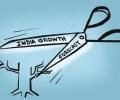
Global forecasting firm Oxford Economics on Monday revised downwards its India GDP growth forecast for 2021 to 10.2 per cent from 11.8 per cent previously, citing the country's escalating health burden, faltering vaccination rate and lack of a convincing government strategy to contain the pandemic. Oxford Economics also said that notwithstanding the likelihood of further mobility restrictions, it expects India's targeted lockdown approach, less stringent restrictions, and resilient consumer and business behaviour to mitigate the economic impact of the second wave.

Bajaj Finance was the top gainer in the Sensex pack, surging around 5 per cent, followed by Bajaj Finserv, HDFC, Tech Mahindra, HDFC Bank, UltraTech Cement and Tata Steel. On the other hand, HUL, Nestle India, ICICI Bank, Axis Bank, SBI, TCS and ITC were among the laggards.
Shares of HCL Tech hit a fresh record high of Rs 1,118.55 on Friday, up 2 per cent on the BSE in intra-day trade, surpassing its previous high of Rs 1,101 touched on Thursday in intra-day deals.

Noting that external risks to global growth has increased significantly now, the Crisil report quotes its parent S&P's forecast of a recession in the US and in the Eurozone, and a record low growth in China, which is seen crashing to 2.9 per cent now, almost half of what it had said on March 5 when it has pegged the same at 4.8 per cent.

IndusInd Bank was the top loser in the Sensex pack, plummeting over 23 per cent. PowerGrid, Kotak Bank, Bajaj Finance, HDFC Bank and NTPC also finished significantly lower. ONGC and ITC were the only stocks in the index that ended with gains. US President Donald Trump has proposed an economic package which could approach $1 trillion, a rescue initiative not seen since the great recession of 2008.

India's sovereign credit ratings do not reflect the economy's fundamentals, the Economic Survey said on Friday and nudged the global agencies to become more transparent and less subjective in their ratings. The Economic Survey 2020-21, tabled in Parliament, said that sovereign credit ratings methodology must be amended to reflect economies' ability and willingness to pay their debt obligations, and suggested that developing economies must come together to address this bias and subjectivity inherent in sovereign credit ratings methodology. "Never in the history of sovereign credit ratings has the fifth largest economy in the world been rated as the lowest rung of the investment-grade (BBB-/Baa3). While sovereign credit ratings do not reflect the Indian economy's fundamentals, noisy, opaque and biased credit ratings damage FPI flows," the survey said.

Automaker Citroen on Wednesday said it has commenced home deliveries of C5 Aircross SUV, its first model in the Indian market. The company, which is a part of Stellantis group formed by the merger of two global auto majors FCA and Groupe PSA, is taking online bookings for the model and then directly delivering the SUV to customers from its Tiruvallur-based (near Chennai) manufacturing plant. It is the first of its kind sales initiative in the country. Citroen currently has showrooms across ten cities in the country, including Bengaluru, Ahmedabad, Chennai, Mumbai, Pune, Hyderabad, Kolkata, Delhi, Kochi, and Gurugram. For customers outside these cities, it has launched a 100 per cent direct online buying for its flagship model.

Moody's Investors Service on Tuesday slashed India's growth forecast for the current financial year to 9.3 per cent saying that the second wave of coronavirus infections hampers economic recovery and increases risk of longer-term scarring. Moody's, which has a 'Baa3' rating on India with a negative outlook, said obstacles to economic growth, high debt and weak financial system contrain sovereign credit profile. The US-based rating agency had in February forecast a 13.7 per cent economic growth for the current fiscal (April 2021-March 2022).

'While we note the very strong cyclical recovery in the economy, we believe there is still uncertainty over medium-term prospects.'

Having lost her job as a stage dancer for film award shows in the pandemic, Smita Soni learnt how to make organic bath and body products. Archana Masih/Rediff.com met her as she sold her handmade items from the boot of her car with baby on her hip.

In the Sensex pack, HDFC, ONGC, Bharti Airtel, Titan, Asian Paints, Mahindra and Mahindra and TCS were the prominent gainers. On the other hand, ICICI Bank, IndusInd Bank, NTPC, UltraTech Cement, Tech Mahindra and SBI were among the major laggards. On the other hand, HCL Tech, Tech Mahindra, HUL, Bharti Airtel and ICICI Bank were trading in the red.

The International Monetary Fund (IMF) on Tuesday cut its economic growth forecast for India to 9.5 per cent for the fiscal year to March 31, 2022 as the onset of a severe second COVID-19 wave cut into recovery momentum. This forecast for 2021-22 is lower than the 12.5 per cent growth in GDP that IMF had projected in April before the second wave took a grip. For 2022-23, IMF expects economic growth of 8.5 per cent, larger than the 6.9 per cent it had projected in April.

LIC owns 3.69 per cent of the total listed universe based on available disclosures, the lowest since at least June 2009.

Fitch Ratings has cut India's economic growth forecast to 8.7 per cent for the current fiscal but raised GDP growth projection for FY23 to 10 per cent, saying the second COVID-19 wave delayed rather than derail the economic recovery. In its APAC Sovereign Credit Overview, Fitch Ratings said India's 'BBB-/Negative' sovereign rating "balances a still-strong medium-term growth outlook and external resilience from solid foreign- reserve buffers, against high public debt, a weak financial sector and some lagging structural factors". The 'Negative' outlook, it said, reflects uncertainty over the debt trajectory following the sharp deterioration in India's public finances due to the pandemic shock.

Gold looks cheap compared to the stock markets that are highly overbought at the moment.

Over the past one-and-half years, the number of stocks trading below their respective face value has increased 29 per cent after a sharp correction in stocks of small-cap companies.

Out of 11 companies that got listed in 2019, nine have outrun the market by gaining more than 10 per cent against their respective issue price.

India's economy will do well once vaccination reaches a critical mass as pent up demand, global recovery and easy financial conditions will boost activities, RBI's Monetary Policy Committee (MPC) member Ashima Goyal said on Tuesday.

HDFC was the leading gainer among Sensex stocks on Thursday, rising by 1.65 per cent, followed by Sun Pharma, ICICI Bank, Asian Paints, Titan and Infosys. TCS was the biggest loser, shedding 1.33 per cent. Ultratech Cement, Bharti Airtel, Kotak Bank and Tech Mahindra were among the other major laggards.

There is immense pressure on Biyani to go ahead with the RIL offer after FRL defaulted on its interest payments of Rs 100 crore on July 22.
